Let the light change life

Among fiber optic products, fiber bundles are easy to overlook — but they're among the most widely used.
Most people think of optical fiber as a single thin strand — light goes in one end and comes out the other. That's correct for a single fiber. But in many applications, one fiber isn't enough, or one fiber simply can't do the job.
That's where fiber bundles come in.
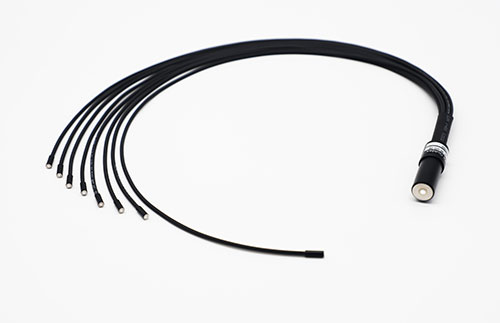
The definition is simple: a bundle is a collection of individual optical fibers grouped together.
A single fiber transmits one path of light — point-to-point. A fiber bundle can do much more: multiple inputs to one output, one input to multiple outputs, or even multiple inputs to multiple outputs. The fiber arrangement at each end can be customized.
This flexibility means light paths are no longer limited to straight lines — they become networks. You can split one light source into multiple outputs, combine several light sources into one, or position output ends in different locations to suit your setup.
Imagine a production line with four inspection stations, all needing illumination. Equipping each with its own light source is costly and space-consuming. A fiber bundle solves this: place one light source centrally, split the light into four branches, and deliver it to each station. One source to maintain, one power supply — simple and efficient.
Some inspection tasks don't need a round spot — they need ring-shaped, linear, square, or other custom patterns. A single fiber can't do that, but a fiber bundle can. The input end stays round to connect to the light source. The output end is rearranged into the shape you need.
Ring-shaped bundles are common for microscope or camera lens illumination — providing 360-degree shadow-free light. Linear bundles pair with line-scan cameras for continuous scanning inspection. Square or rectangular shapes suit area-scan cameras or specific part geometries.
In high-temperature, confined, or corrosive environments, you can't place the light source directly — but you can run fibers. Fiber bundles deliver light from a safe location to where it's needed. With different fiber materials — plastic (POF), glass (GOF), or quartz — you can cover a wide spectral range from near-UV to mid-IR.
Fiber bundles seem straightforward, but a few key parameters matter during selection:
Fiber bundles are found in many applications, but they fall into a few broad categories:
Hecho Technology has nearly two decades of experience in fiber bundles. We offer three material options: plastic, glass, and quartz. Branch configurations include straight, Y-shape, and multi-branch designs. Output shapes are customizable. Connectors cover SMA905, FC, ST, and other standards, with custom options available.
In short: whatever shape, material, or configuration you need — Hecho can deliver.
If you're designing a system that needs to split, combine, or reshape light, a fiber bundle is worth considering.


 IPv6 network supported
 English
 简体中文
简体中文